Wastenify is an ongoing mobile product designed to make waste collection easier to request, track, and verify. The initial experience focuses on residents and businesses in Accra, giving users a simple way to request a pickup, describe the waste they need collected, select a location, and follow the collection process. The wider system is also being designed to improve accountability by using location data to help verify where collected waste is ultimately disposed of.
Live links
My responsibilities
I am working across the product design and technical implementation of the mobile experience. My responsibilities include translating the product requirements into user flows, designing the interface, building the mobile experience, defining how the app communicates with backend services, and working through location-aware features such as pickup coordinates, mapping, tracking, and geofencing.
Because the product is still in development, the current work is focused on establishing the core user journey and the technical foundation required for future pickup, payment, notification, collector, and disposal workflows.
Year
2025-2026. Ongoing.
Tools and technologies
The current technical direction includes:
- Mobile applications targeting Android and iOS
- Cloud-hosted backend services and APIs
- A database layer for users, pickup requests, jobs, locations, and timestamps
- GPS and device location services
- Mapping and routing integration
- Geofencing for authorized disposal locations
- Push notifications and SMS for important service updates
- Mobile money and cash payment workflows
- Secure API communication between the mobile app and backend services
The supplied project requirements define the capabilities and integration direction, while some provider and framework choices are still being implemented or finalized.
Project context and challenge
Waste collection can become difficult when requesting a pickup depends on irregular communication, limited visibility, or unclear collection schedules. There is also a second problem after collection: confirming that waste reaches an appropriate disposal location rather than being dumped somewhere unauthorized.
Wastenify approaches both problems as a connected product experience. For customers, the goal is to make requesting a collection feel as straightforward as using a modern on-demand service. For the operational side of the platform, location data creates a way to connect a pickup request to the collector, the collection point, and the eventual disposal location.
The initial product is being designed for Accra, where the experience also needs to account for mobile connectivity, different payment preferences, and first-time users who need a clear and simple interface.
Project goals
- Make requesting a waste pickup simple enough to complete from a mobile phone in a few steps.
- Capture enough information about the waste and pickup location to make collection easier to coordinate.
- Give the platform a reliable location layer for pickup tracking and disposal verification.
- Support both digital and cash-based payment workflows.
- Build a technical foundation that can later support more waste categories, recurring pickups, additional collectors, and expansion beyond the initial pilot.
Process and key decisions
One of the main product decisions has been to keep the customer journey focused on the information required to successfully arrange a collection. Instead of presenting operational complexity to the user, the mobile flow breaks the request into understandable steps: start a pickup, identify the waste, provide the collection location, and continue through the booking process.
Location is not treated only as a convenience feature. It is part of the product's accountability model.
The system is being designed to capture GPS coordinates and timestamps around pickup and disposal events. Collector location updates can support tracking while a job is active, while geofencing can compare a disposal location against boundaries defined for approved sites.
This creates a distinction between simply knowing where a collector is and being able to validate whether an important event happened within an expected geographic area.
Solution
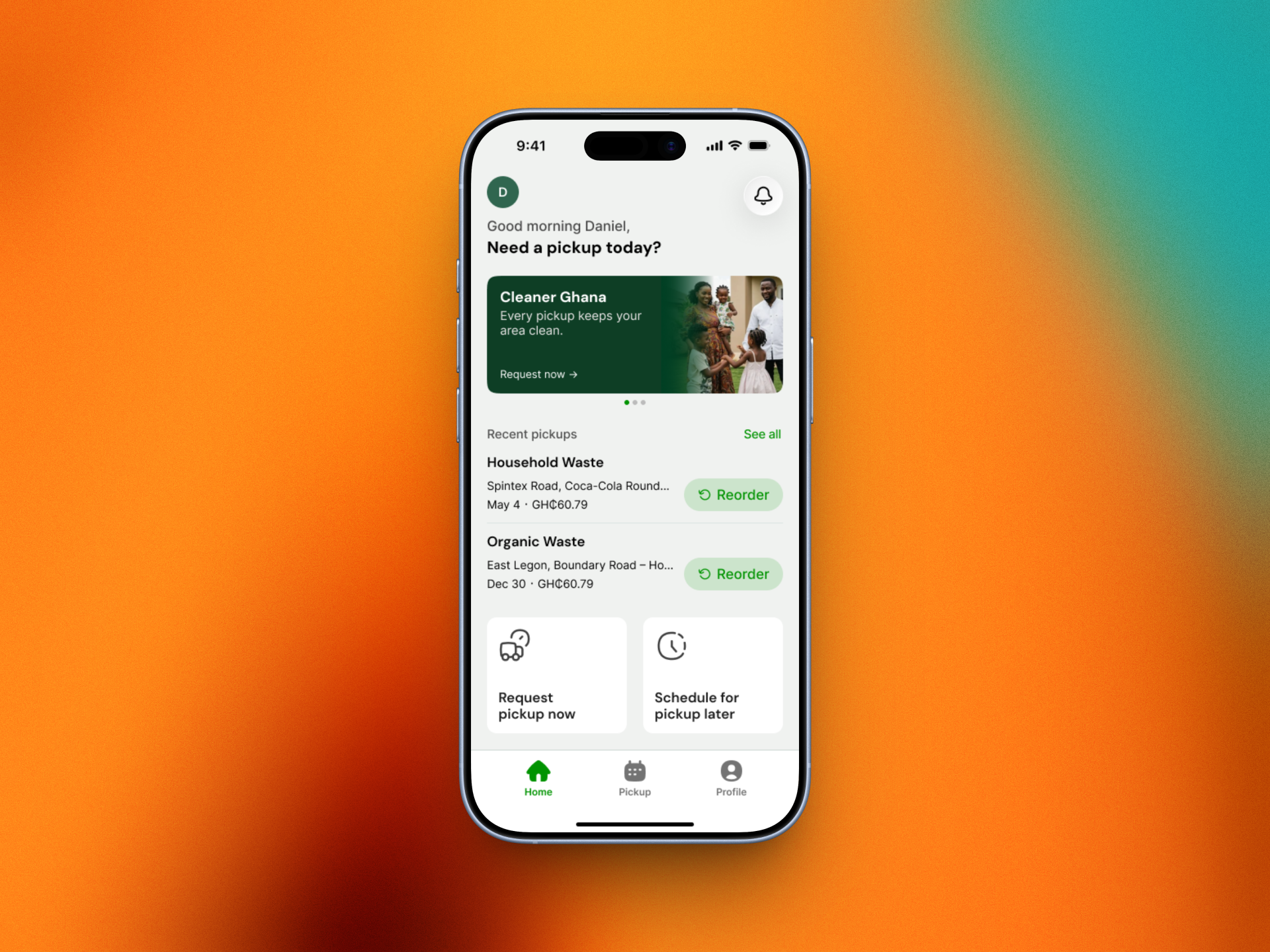
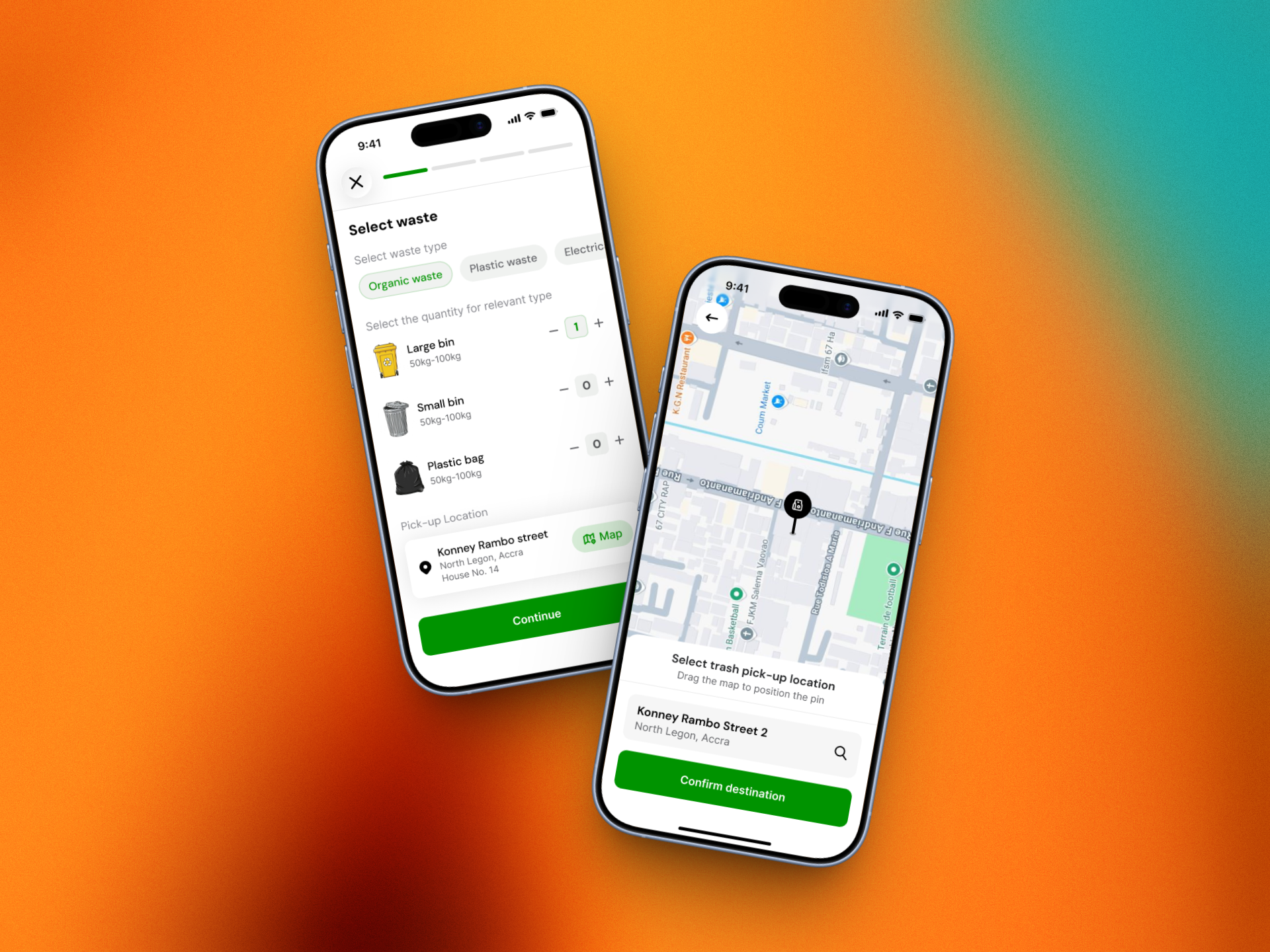
The mobile app brings the main waste collection journey into a single interface. The current screens establish the foundation of the experience: starting from the home screen, selecting the waste to be collected, and identifying the pickup location.
These screens are intentionally only part of the wider platform. The product is still being developed, and later stages of the experience are expected to connect the user journey with collector assignments, notifications, payments, live location information, and disposal verification.
Starting a pickup
The home experience is designed to make the primary action immediately understandable. Rather than making users navigate through multiple service categories before they can do anything, the interface leads with the waste collection journey.
This gives the app a clear purpose from the first screen and creates a foundation for adding scheduled and recurring pickups without making the initial experience unnecessarily complicated.
Selecting waste and Choosing the pickup location
The waste selection flow helps users quickly describe what needs to be collected. Users can choose the type of waste and indicate the approximate amount, giving collectors useful information before accepting or arriving for a pickup.
The flow is currently focused on general household waste, while the structure is designed to support additional categories such as recycling and organic waste as the service expands.
The pickup location flow uses device location services and mapping to help users accurately specify where their waste should be collected.
The selected coordinates become part of the pickup request and can support collector navigation, routing, and job tracking. GPS coordinates and timestamps can also be captured during active collections, creating a location history that supports both the customer experience and the wider accountability system.
Geofencing and disposal verification
Geofencing extends the location system beyond navigation.
Authorized disposal sites can be represented using stored geographic coordinates and defined boundaries. When a collector records a drop-off, the platform can compare that GPS position with the approved geofence.
A valid location can support disposal confirmation, while a drop-off outside the expected area can be flagged for review. This makes geofencing an operational control rather than simply a map feature.
The project requirements also connect disposal validation with collector accountability, including GPS and timestamp logging and the ability to flag non-compliant drop-offs.
Challenges and tradeoffs
Location-aware products have to balance accuracy, reliability, connectivity, battery usage, privacy, and a simple user experience.
Continuous high-frequency GPS updates can provide more location detail, but they can also consume more battery and mobile data. Lower-frequency location updates are more efficient but provide a less detailed representation of movement. The implementation therefore needs to use location updates intentionally based on the state of a pickup rather than treating every user or collector as continuously trackable.
Connectivity is another consideration. The product requirements specifically account for areas with weaker internet access, so important actions such as capturing pickup or disposal information need to be designed with unreliable connections in mind.
Geofencing also depends on the quality of the approved disposal-site data. A location check is only useful when the stored coordinates and boundaries accurately represent the real site.
Validation and outcomes
Wastenify is still in development, so I am not presenting usage, conversion, or operational metrics as completed outcomes.
The work completed so far is focused on defining the product requirements, designing the mobile experience, and building the foundation for the customer pickup journey and its supporting location-aware architecture.
The current portfolio preview intentionally shows only a small part of the application while the wider system continues to be developed.
Learnings and next steps
A key lesson from the project is that location can play two very different roles in the same product. At the customer level, it reduces friction by making a pickup point easier to specify. At the operational level, the same type of data can become part of an accountability system through timestamps, collector tracking, and geofenced disposal validation.
The next stages of the project include continuing the mobile implementation and connecting the customer journey with backend services, collector workflows, notifications, payment handling, mapping and routing, and disposal verification.
As the product develops, the location architecture will also need to be tested against real pickup and disposal conditions so that geofencing thresholds and tracking behaviour reflect how the service operates in practice.